

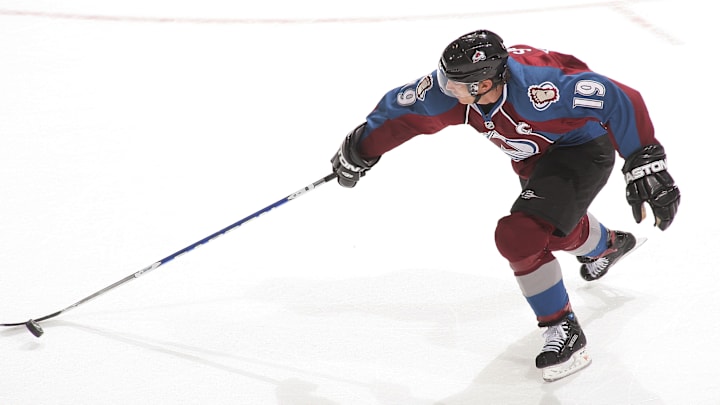
It's Thursday, November 6, 2008. The Colorado Avalanche are at home at the Pepsi Center for a 6pm bout with their divisional rival, the Minnesota Wild. It's an evening of clear skies and moderate weather; the temperature is in the mid-50s in Denver, gradually dropping as the sun has already set by the time of opening puck-drop. Despite sitting at an unimpressive 5-8-0 at this point in the season, the expectations are high for this Avs team — one that beat the Wild 4-2 in the Western Conference Quarter-Finals and was ultimately swept by the eventual-Cup-winners, the Detroit Red Wings, in the Western Conference Semi-Finals the previous season.
On the Wild side, the season projections are also high. They won their division (the now-defunct Northwest Division) after a hard-fought 2007-08 campaign. Despite losing in the first round of the playoffs to the Avs, the team is well-oiled and running smoothly to kick off 2008-09; by November 6th, the Wild hold an 8-3-1 record, thanks, in part, to hot starts for three Avs alum, both past and future: Andrew Brunette, Owen Nolan, and Brent Burns. The team plays a defensively-oriented style of hockey, and they are ready to limit the Avs' ever-dangerous offense. It's shaping up to be an exciting early-season contest.
The stage is set. The crowd of 14,500 fans is eagerly-awaiting puck-drop. The star players on both sides warm-up as the arena steadily fills up. The always-electrifying Marián Gáborík, who led the Wild in points the season before, is ready to put on a show and silence the crowd. A pair of 22-year-old Avs phenoms, former Calder Trophy runner-up Paul Stastny and former first-round draft selectee Wojtek Wolski, stretch and prepare for the long 60 minutes ahead. 25-year-old homegrown goaltender Peter Budaj is scheduled to start for the Avs; he is going through his pre-game routines. 39-year-old Joe Sakic — the Avs' captain, franchise icon, and superstar center who just signed a one-year $6M deal to play his 20th season with the team — is right there, in the Pepsi Center, getting ready... to watch the game from the press box. Wait, what? Time for a deep-dive.
December 1, 2007 — Listed as Day-to-Day (Groin)

For someone who played 1,378 games in his NHL career, Joe Sakic had a comparatively healthy tenure as a pro. In fact, across his 20 seasons, he played every single game in eight of them (1989-90, 1990-91, 1993-94, 1995-96, 2000-01, 2001-02, 2005-06, 2006-07) and once missed just a single game (2003-04). As his career persisted and his body endured further wear and tear, however, his injuries began to mount, and both of his final two seasons in the NHL were injury-shortened. These injuries, and various, related setbacks, unfortunately came to define much of the last portion of his hockey-playing career.
It began with a groin injury that occurred on November 30 in a game against the San Jose Sharks. Sakic played the duration of the game — and registered a secondary assist on the an Andrew Brunette powerplay goal in the waning seconds of the middle frame — but he had clearly tweaked something. The discomfort kept him out of the lineup for the Avs' December 1st tilt against the LA Kings, which ended a streak of 232 consecutive games played for the Burnaby, BC native. That streak first began on January 6, 2004. He remained off the active roster for a significant amount of time; what was initially considered a minor, day-to-day issue soon became something much more substantial.
December 30, 2007 — Undergoes Surgery (Hernia)

Despite the initial, official day-to-day listing, Sakic barely skated or practiced with the team, which raised concerns that there was more damage to his body than initially reported. These worries were ultimately confirmed: as the Avalanche faced off against the Phoenix Coyotes on a New Year's Eve tilt, Sakic went under the knife to fix the hernia that had become unmanageable and a hindrance to his ability to play at a competitive level. This came after some initial setbacks stemming from the groin injury first sustained at the beginning of December. Day-to-day became week-to-week; week-to-week ultimately spanned months — it was unclear when, exactly, the Avs' captain would be cleared to play once more. The team's physician, Andrew Parker, spoke to the media once the surgical determination was made:
"Joe’s rehabilitation has not progressed as anticipated and uponAndrew Parker, Avalanche team physician
further evaluation the decision has been made to perform surgery in
order for him to fully recover"
Projected recovery time for a hernia surgery is 8-12 weeks, so Sakic had to watch almost half the season, in total, from the press box. For Sakic — someone who had, day after day, for nearly 20 years — this was more of an obstacle than the injury or the necessary rest and recover; injuries happen in a high-intensity contact sport like hockey, but it's the waiting around and the inability to support the team in any actionable capacity that is the true strain on any world-class athlete.
February 24, 2008 — Returns After 38 Missed Games

The 38 games that the then-38-year-old Sakic missed as a result of both the initial injury and the post-surgery recovery marked, at the time, the most consecutive missed games of his career. He returned to the lineup to faceoff against the Edmonton Oilers, and he amassed 15:24 of ice time in his roster reinstatement. He also registered a helper on the Avs' second (and final) goal of the game. The team lost 3-2 after allowing a trio of unanswered goals after potting the only two goals in the first period. In those 38 games, the Avs went 17-15-5 — a little below .500 in terms of winning percentage. It was nothing terribly drastic; it didn't threaten to derail the team's season, but the Avs ultimately finished second in the Northwest Division (behind the Minnesota Wild) by just three points in the standings.
That stretch of games included a span of five straight losses before getting back in the win column with a shootout win on Friday, February 22, 2008. That game served as Paul Stastny's return from a groin injury of his own — one that kept him out of the lineup for a comparatively-measly 14 games. Those five consecutive losses formed the longest losing streak the Avs had in the 2007-08 season. While the Avs lost in Sakic's return to play, they then went on a six-game winning streak, which was the most wins in a row the team had all season. Based solely on those statistics, Sakic's influence on the team's success was undeniable.
May 1, 2008 — Avalanche Eliminated from Playoffs

After dispatching the Minnesota Wild in six games in the 2008 Western Conference Quarter-Finals, the Avs were simply a mismatch against their longtime rivals, the Detroit Red Wings, in the 2008 Western Conference Semi-Finals. the Wings were an authentic contender, and the Avs, while competitive, were not many media pundits' pick to win it all. Going into the season, they generally ranked around the middle of the pack in terms of projected Cup odds; by season's end, they finished 10th overall, which was seen as a win. The Avs lost by one goal in both Game One and Game Three (a 4-3 defeat both times), but the second and fourth contests were not close (5-1 and 8-1, respectively). This convincing sweep of the Avs illustrated why the Wings were fully-deserving representatives of the Western Conference in the Stanley Cup Finals in both the 2008 and 2009 Stanley Cup Playoffs.
The four consecutive wins in the second round were practically inevitable; the Avs had a slew of injuries: Peter Forsberg, who only played nine games in the regular season during his return to Colorado, missed most of the Western Conference Semis. Paul Stastny, who had been the team's leading scorer that year, was also unavailable for part of it, as he was battling a knee injury. Additionally, three of the team's other top forwards, Ryan Smyth (Foot), Marek Svatos (Knee) and Wojtek Wolski (Ribs) were also unable to play through the entire second round, with Svatos missing the playoffs entirely. Alongside the fact that the Wings were mostly healthy (only Chris Chelios was unable to play), it felt like the Avs (who finished the regular season with 95 points) were on life-support against Detroit (who recorded 115).
August 27, 2008 — Signs a One-Year, $6,000,000 Contract

After much deliberation and considerations of retirement, Sakic — who was unhappy with the way his 19th season panned out in terms of both personal performance and the way the season concluded — signed a one-year deal to remain in Colorado for another season. Sakic spoke to the media shortly after making his decision:
"It was just a frustrating year. With the [groin] injury and the rehab [after hernia surgery], I was mentally tired. At that point, I was almost ready to move on and spend time with my family. It wasn’t a physical thing. Just mentally, I was drained... with the injury and coming back, doing the rehab for three months... at the end of the year, I didn't want to think about hockey... The game is the easy part. It’s what you do off ice in preparation to give yourself a chance to be the best that you can be. That’s what took the longest. As the summer went on, I realized I really want to do that again."Joe Sakic
Fully aware that his age would ultimately become an obstacle that would necessitate retirement, this marked the third consecutive one-year deal for Sakic and the Avs. This third one ensured he would appear in his 20th NHL campaign, all of which (apart from that one time he almost left for the New York Rangers) spent with the Quebec Nordiques/Colorado Avalanche. In each of his last four years in Denver, his salary fluctuated to fit the needs of the team and the outlook of his ability to contribute:
Season | Contract AAV |
|---|---|
2005-06 | $6.66mil |
2006-07 | $5.75mil |
2007-08 | $6.75mil |
2008-09 | $6mil |
2005-06: Just after the NHL introduced its salary cap model after negotiations (disagreements) with the NHLPA resulted in the cancelation of the 2004-05 season, Sakic's pre-existing contract was modified to fit within the terms of the new Collective Bargaining Agreement (CBA).
2006-07: His figure was negotiated down as a way to help the team manage the new constraints of the CBA and the salary cap. The Avs had other, notable players, like Rob Blake, that needed to be re-signed, as well.
2007-08: Sakic, who in the '06-07 season put together his first 100-point-campaign since '00-01, earned a $1mil raise.
2008-09: As a gesture/hometown discount/recognition of his now-evident physical decline, Sakic took a bit of a pay decrease, but he was still the second-highest-paid player on the team, behind only Ryan Smyth, whose contract amount was $7,250,000.
November 6, 2008 — Listed as Day-to-Day (Back)

Just 13 games into the 2008-09 season, Sakic was already out of the lineup because of an injury, this time to his back. It occurred in practice the day prior, but it didn't appear too serious. The initial prognosis was day-to-day, but after that same timeline turned into 38 missed games the prior season, there were concerns, naturally, that this could be a sign of bad things to come or that it could be indicative of a more serious, underlying issue. Worst of all, if another part of Sakic's body was beginning to deteriorate, it could mean an unceremonious end to his incredible career. The hernia was remedied, but now there was a new area of concern. The back injury forced him to miss the November 8 matchup against the Wild, and his team certainly missed him on the ice, as the Wild beat the Avs 3-1.
November 8, 2008 — Returns After One Missed Game

Much to the collective relief of Avs Nation, Sakic came back after missing only one contest, and the Avalanche eked out a 1-0 victory in his return. And Sakic found his way onto the scoresheet, albeit not in relation to the lone goal that was scored; he was assessed a two-minute minor for interference during the first period. Regardless of his impact on the ice, it was simply impactful that he was on the ice at all and and not confined to a luxury box in the Pepsi Center. The win got the Avs back in the win column for the first time since October 25.
Then, at the start of the second period: no Sakic. After 20 minutes of play (in which time Sakic had 7:19 on-ice), he did not return for the last two-thirds of the contest. Unfortunately, but unsurprisingly, the decision was made because Sakic had reported feeling "back soreness" and could not carry on with the game. Did he rush his recovery? Perhaps, in a preemptive attempt to show that the injury wasn't a concern, he didn't show enough concern for his injury? It's hard to say for sure. Regardless, he had reinjured himself and a new recovery timeline needed to be evaluated. Fans in Denver just had to wait for his return, hopefully sooner rather than later.
November 12, 2008 — Listed as Day-to-Day (Back)

Because of the re-aggravated back injury, Sakic found himself back on the proverbial shelf, beginning on November 12th. He was again listed as day-to-day, but this came with obvious doubts, given that the one from 2007-08 lasted months and the most recent one was clearly worse than anticipated. Fans began to feel they had passed the event horizon of Sakic's healthy years and rightly feared that this might be the new normal — they were getting used to seeing him as a spectator instead of a player, especially after missing almost half of the former season. On the night that he was once again ruled unable to play, the Avs faced off against the Vancouver Canucks at General Motors Place in downtown "Vancity." Despite not having their captain present, the Avs recorded a much-needed win; the result was a 2-1 shootout victory for Colorado, which brought the Avs to a 7-8-0 record on the year.
November 24, 2008 — Listed as Day-to-Day Again (Root Canal)

To add injury to injury, Sakic was set to return after a five-game absence caused by the re-injured back, but he was forced back into the injured list by a sudden tooth infection, one that required a root canal. Resultingly, his return to the lineup was delayed an additional game. Because of Sakic's inability to stay in the lineup, the young players on the team — chiefly Marek Svatos (26), Cody McLeod (24), Paul Stastny (22), Wojtek Wolski (22), T.J. Hensick (22), and Chris Stewart (20) — needed to begin stepping up in their captain's absence, especially as Sakic's health was waning and time was catching up to him.
They performed admirably given the trajectory of the team and the challenges presented. The player who perhaps most exceeded their expectations in 2008-09 was the Avs' enforcer, Cody McLeod; he, in just this one season, recorded 15 goals — equal to nearly 21% of the goals scored in his career (72). His next-highest goal total in any season was eight, which he reached in both 2012-13 and 2015-16. He added five assists, which brought him to 20 points on the year, which is the highest he had in any one season.
November 26, 2008 — Returns After Six Missed Games

After missing a combined six games with injuries (five because of his back and one because of the root canal), Sakic returned to action on November 26 against the St. Louis Blues. He spent 15:24 on-ice, recorded a single shot on net and was quiet, otherwise. He wasn't needed on the scoresheet, however, as the Avs managed to come out on top by a score of 3-1. He was a non-factor during the game, but, once again, it was refreshing to simply see him back on the ice.
With the team around him getting healthier (Stastny also missed time early in the season) — and the only major injuries at the time being Darcy Tucker's knee injury and a handful of missed games for John-Michael Liles as well — there was an obvious opportunity for the Avs to right the ship with 3/4ths of the season still in front of them. After the win against the Blues, the team held a 10-11-0 record, which wasn't great, but there was still plenty of time in which to get back on track, especially with Sakic back and hopeful to become a key contributor once more.
November 28, 2008 — Exits Mid-Game

Two days and 28 seconds worth of ice time (totaling exactly one shift) later, Sakic was, frustratingly, unable to finish yet another contest. He departed for the dressing room after barely playing at all. It was assumed that the back had still not fully healed, and that did wind up being the culprit. His season was, somehow, in worse shape than the one prior. Whatever the Avs' training staff's initial diagnoses had been, it was basely evident that something was either not being treated correctly or was indicative of a more serious, underlying issue. The injury/injuries were getting worse and not better — the status quo couldn't remain unchanged any longer, for the fans were upset, and the front office was running out of excuses. The Avs' staff continued to spin the narrative that everything was fine:
"He's a tremendous athlete. I know he'll do everything he can within his power to get back to being 100 percent. If there's an athlete that can come back from something like this in the minimal amount of time it would be Joe... He's a guy that knows his body probably as well as any professional athlete I've been around. When he came back he felt great, he looked great you could see how he was skating it looked like he had his jump back and the back wasn't an issue at all."Avs head coach Tony Granato
Things were not fine.
November 29, 2008 — Out Indefinitely (Herniated Disc)

The one main takeaway that supports the idea that Sakic shouldn't have attempted a 2008-09 comeback is the nature of his injuries. There were no jarring open-ice hits. There wasn't a moment where he took a spill and tumbled into the corner boards. He wasn't hit in the face with a puck. He wasn't cut by a skate blade. No, his injuries occurred in ways perhaps more concerning than any of those: they happened in off-days when he was arguably least-at-risk of sustaining an injury. The incepting '08-09 back injury was from a team practice. The root canal: apparent bad oral hygiene? The most recent back setback developed while weightlifting.
Why is this worse? Well, a concussion has a specific set of recovery steps. A broken leg can be cast and set to heal. These fluky, bizarre injuries of Sakic's were less treatable, as they were not traditional hockey injuries. They were merely resultant of a 39-year-old's body doing what 39-year-old bodies often do: deteriorate. The timeline was ultimately set to six weeks, but the media in Denver was beyond frustrated with how Sakic and the training staff had handled Sakic's injuries. The decision for Sakic to return for a 20th season — one that was, before any of the back problems really started, already considered a bad idea — was becoming a nightmare scenario for everyone involved. These sentiments were perhaps best illustrated by Mile High Hockey's Joe Dunman:
"There’s really no limit to the amount of damage the Avalanche medical and training staff can wreak on a hockey player’s body. It’s a wonder any of those guys can still skate at all."Joe Dunman
December 9, 2008 — Snowblower Incident

In a moment that now exists in the annals of hard-to-fathom off-ice hockey injury history, Joe Sakic — already set to miss at least a month an a half because of his back — befell an injury so unusual that it could only be taken as a sign from the hockey gods that his playing days are done. Move over Dustin Penner (tweaked his back while eating pancakes in 2012), Sami Salo (bit by a venomous snake in Finland), Brent Sopel (strained his back reaching for a cracker), and Glenn Healey (sliced his hand on his bagpipes) — Joe Sakic isn't satisfied with just dominating the record books; he wants to be featured in this list, too.
After a recent snowstorm befell Denver, Sakic, perhaps bored of his now-routine absence from the ice and snow of an NHL rink, and despite the severe back injury already plaguing him, decided to conduct some yard work and a casual bit of snow blowing. Before he had finished the chore, he attempted to dislodge some snow from the machine's auger, but — despite the team remaining adamant that the snowblower was turned off, which is surely a lie — the machine proceeded to mangle him, breaking three of his fingers and tearing through some of the tendons in his hand. He received emergency surgery to repair things, and he was honestly lucky that he didn't lose his fingers — and, by extension, his entire hand — altogether. Legend has it that his yard remains half-snow-blown to this very day...
In an interview with the Denver Post, Avalanche VP Jean Martineau tried to get out in front of any criticism or dismay:
"Basically, it's a mistake. He's a 39-year-old adult who made a mistake. He put his hand where he should not have put it. He's, in a way, lucky. He'll have a full recovery... [Sakic is] very upset with himself. He's very, very mad at himself. I've never seen him like that, and I've known him for 21 years. He knows he made a mistake... [despite being injured already, he was snowblowing because] you just have to walk with the machine. There was no problem [with him] walking. The machine does all the work and it's basically just going for a walk. It's just an unfortunate thing that happened."Jean Martineau
The rest of the Avs' front office, as well as Sakic's fellow teammates, also went into immediate damage control mode. Adam Foote, who became Sakic's captaincy successor, stated that it "could've happened to anyone" (which is allegedly true; over 5,000 snowblower-related injuries were recorded in a single year when a study was conducted in 2005), and head coach Tony Granato parroted, almost identically, the same contrived lines he spun when Sakic was first put on the IR before Snowblowergate:
"If there’s anyone that’s going to get back quicker than you’re supposed to … it will be Joe. I’m not worried about that... In a few months, he’ll be back to normal."
When all was said and done and all the snow had fallen, nothing could change the fact that Sakic's injury-laden season was capped off in one of the most unbelievable ways possible. A snowblower had done more damage to his body than pretty much any single player in the NHL ever did. The circumstances were unimportant (and Sakic was the first to admit the outlandishness of it all; he remained sheepish about the incident even years after it took place), and the only path forward (despite remaining half-covered in snow) was to endure, and one, definite takeaway was this: With the Avs on track to miss the playoffs in 2008-09 and the regular season set to end on April 12, Sakic's total estimated recovery time, which was announced to be three months provided there were no additional setbacks, left him a very small window in which to return to play before the season ended and pressure would once again mount for him to retire.
January 7, 2009 — Undergoes Surgery (Herniated Disc)

Remembering that there was more wrong than just his mangled fingers, Sakic went through with the pre-planned back surgery, which was performed to repair a herniated disc. There was still a hope that he could return before the end of 2008-09 campaign, but if he was able to, it wouldn't leave him with much time in which to influence the outcome of the Avs' season, which was, by the time of Sakic's back surgery, still salvageable. As the calendar flipped into the new year, the Avs were 19-17-1, very much on par with the where they were a few months prior: hovering around a 0.500 wins percentage. Sakic spoke about his desire to get healthy again, which would allow him to help the club make a second-half push:
"Right now, it’s still too early for a timetable,” Sakic said. “I definitely want to be back sometime near the end of the year. I’m not too sure right now, but as long as rehab keeps working and my back does fine and progresses, hopefully I’ll be back by the end of the year... It’s been three months since I’ve done anything... As long as my back keeps progressing, whenever I’m ready to go, I’m going to be back."Joe Sakic
In the now-14-years since the Avs were brought into the NHL fold — after a more than three decades (spent, in parts, in both the WHA and the NHL) — the Avs had only missed the playoffs a single time: 2006-07. At the rate at which the Avs were performing, there was no initial doubt that they would miss post-season play in 2008-09, but there was still much work to be done, and the end of the season would have to be considerably better than its beginning. Time would tell if Sakic would be 100% again, if Sakic could help the Avs once again challenge for the Stanley Cup.
April 12, 2009 — Misses Remainder of Season; Avs Miss Playoffs

Ultimately, Sakic was not able to return. He feared a third premature attempt at taking the ice, so he was unwilling to take the risk. Without Sakic and with some franchise-worst drop-offs as the second half of the season progressed, the Avs were in a complete and utter tailspin. From the time he was first out of the lineup because of the herniated disc, the Avs played 60 games to complete the 2008-09 season, and Sakic appeared in none of them. Their record during that stretch was an abysmal 22-38-1, including an eight-game losing streak that spanned the entire second half of March up through April Fool's Day, a fitting exemplification of how much of a joke the Avs had become. These eight consecutive losses formed the largest losing streak the team had incurred since their time as the Nordiques. The did win their next game, on April 5, and then proceeded to lose the remaining four games of the season, leaving them with a 1-8-4 record, firmly burying them in the Western Conference's basement by the time the playoffs started.
The 2008-09 season was, at the time, the worst season the franchise had put together since its relocation from Québec when the Nordiques went almost the entire month of January without a win in 1993. Even if the Avs had won their remaining seven games, they still wouldn't have beaten their own franchise-worst points total, signifying just how badly things had gone in Denver. All told, Sakic played in just 15 contests that season, his least by far in any of his 20 years in the NHL, with only the prior, 2007-08 season coming anywhere close (44GP). Some additional, depressing statistics: Their 69 points saw them finish a whopping 16 points behind the next-worst team in the Northwest Division (the Edmonton Oilers, who recorded 86) and 10 points behind the next-worst teams in the entire Western Conference (the Los Angeles Kings and the Phoenix Coyotes, who both recorded 79 points). In terms of the league, as a whole, only the Tampa Bay Lightning (66) and New York Islanders (61) had worse years in '08-09 than the Avs.
July 9, 2009 — Officially Retires

In a bit of foreshadowing (sort of like how all the time he spent watching the Avs from the press box would go on to become his job once he entered the front office), Sakic saw himself at the center of a press conference, one that was held just two days after his 40th birthday. A sigh of collective relief — and an influx of nostalgia for the better, healthier days of both Sakic and the Avs — swept through Denver like a snowstorm (somebody not named Joe Sakic should probably clear that) when the press conference was evidently held to formally announce Sakic's retirement from the NHL. The dead giveaway might have been the six different Sakic jerseys that adorned the front of the table at which general manager Pierre Lacroix, assistant general manager Greg Sherman, player agent Don Baizley, Joe Sakic, and Sakic's wife, Debbie, sat behind.
Fans appreciated all that Sakic put his body through, but the thought of another tumultuous season for the franchise's most beloved son was unbearable, and all parties agreed it was time to hang up the skates. The moment was bittersweet, and it felt almost like a distraction from the prior season, a final nostalgia trip for a now-bygone era of Avs hockey, a celebration of what was as a means of avoiding the acknowledgment of the troubles ahead — Sakic had earned this. In his final season, Sakic could've dressed in zero games and somehow put up a plus-minus of -100 in those zero games, and his fans, teammates, and representatives would've still given him this opportunity to officially, gracefully end his professional hockey career. And, despite the various blemishes, backaches, and blower-related-blunders that came to define the last 10% of his time in the NHL — what a career it was for Super Joe.
October 1, 2009 — Number Retirement Night

The setbacks of the 2007-08 and 2008-09 seasons would not, ultimately, stain Sakic's legacy. In fact, his sheer determination and drive to continue playing only bolstered his already-legendary status in the history of both the Colorado Avalanche/Québec Nordiques and the entire NHL. Joe Sakic — a veritable titan of his time, a player who made those around him better and those whom he played against feel laughably unable to contain him, a quiet, dedicated leader, an example-setter, a father, a husband, and an all-around good dude — had one of the greatest hockey careers ever. And to make it all the more sweet, he never once put himself before the team, even as his body failed him.
Accordingly, in the very first game of the ensuing season, Sakic's name and number were raised to the rafters of the Pepsi Center. Players wore commemorative captain's patches that paid homage to Sakic, which was especially poignant: the ceremony also served as send-off to the only captain the Avs had ever known. As soon as the puck dropped after ceremony's end, the recently-named next captain, Adam Foote, would take to the ice and would officially represent the Avs as team captain. After a two-year hiatus preceding his retirement, Sakic rejoined the team, first as an advisor, then in the hockey operations department, then as the general manager, and now as the president of hockey ops for the Avs.
For the majority of his career, Sakic, amongst many other things, was known to be one of the best-conditioned players of his time. Sakic saw the end of the post-game-beer-drinking era and was there at the advent of the NHL's emphasis on and embracing of metrics, training, and — especially in the off-season — off-ice conditioning. But having begun in an era that didn't care much for staying in shape between paychecks — and trying to remain competitive as the years went on — likely took an extra toll on Sakic's body. Despite this, his career ended on his own terms, in his own time, even if it didn't always go according to plan.
As the days since he last saw ice time continue to blur in the rearview mirror, and as Sakic continues to cement himself, now as an executive, as one of the best in the league, the concern and the criticism of those last few seasons has faded. In its place, the focus had rightly been returned, to all the wonderful memories he has provided the Avalanche franchise since first he donned a Nordiques jersey (then stuck with number 88 because 19 was accounted for) in 1988. There will never be another Joe Sakic, and not even 400ccs of sharp snow-throwing steel could keep Sakic down.
Statistics, data, and analytics provided by The Athletic, BarDown, Bleacher Report, the CBC, CBS, Colorado Hockey Now, The Denver Post, the DNVR, ESPN, The Hockey News, Hockey Reference, The Hockey Writers, HockeyDB, the Los Angeles Times, Mile High Hockey, Mile High Sports, the New York Times, the NHL, the NHL Network, NHL Records, the NHLPA, PuckPedia, QuantHockey, Reuters, SB Nation, Sports Illustrated, sportslogos.net, Sportsnet, theScore, TSN, Yahoo Sports
 Add us as a preferred source on Google