

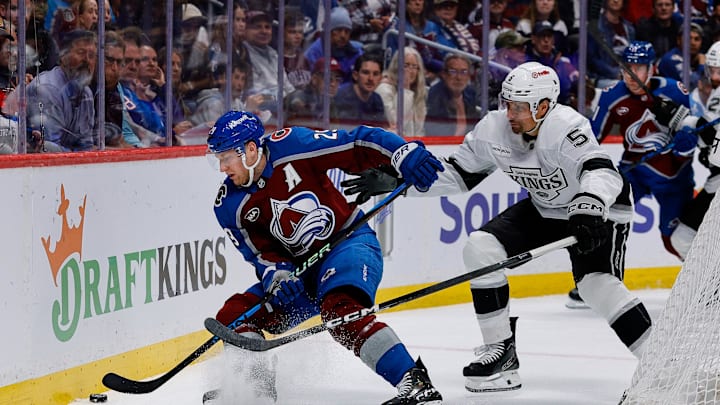
The Stanley Cup playoffs have begun and the Presidents’ trophy-winning Colorado Avalanche have a 2-0 series lead over the Los Angeles Kings. These wins haven't come easy and one major reason for that is the power play is struggling... again. After finishing the regular season ranked 27th in the league with the man-advantage, the Avs still seem to be struggling. Some are already talking about the power play dooming the Avs Stanley Cup hopes.
The power play was supposed to be different this season, aftter moving on from former assistant coach Ray Bennett and hiring Dave Hakstol in the offseason. The reason for that switch? A power play collapse in last year's playoffs against the Dallas Stars. The Avalanche went 3 for 22 (13.6%) in that series, including failing to convert in the final 3 games of the series. This was a focus coming into the season, throughout the season, and it still seems they just haven't figured it out.
Is it time to panic?
I've been saying no to this question all season long. I figured that if the power play struggled like this in the playoffs, I'd finally answer yes, but here we are. No, I don't think it's time to panic. Here's why.
There was a short time where the Avalanche power play looked like they were starting to put it together. After Nazem Kadri arrived at the trade deadline, the Avs led the league in power play goals for the month of March. But once Kadri and Cale Makar suffered injuries late in the season, the power play came crashing back down. This offers a glimmer of hope.
The power play against Los Angeles so far
With seven power play opportunities, the Avalanche have yet to convert this postseason. Excellent goaltending from Anton Forsberg and an aggressive Kings penalty kill have prevented the Avalanche from putting it in the back of the net. This high pressure defense on the Avs has even limited them at 5-on-5, where Colorado has been the most dominant all season.
The problem that the Avalanche have had in this series is dealing with the physical Kings defense. The Avalanche have been unable to establish anything in front of the net. The Kings have also done an excellent job of taking away passes. With that, it makes any strategy the Avalanche could use pretty much useless. However, I think head coach Jared Bednar should continue to use the current set up.
Watch out, Kings.
— Colorado Sports Night (@COSportsNight) April 22, 2026
An Avalanche warning from head coach Jared Bednar with Colorado up 2-0 in the series:
“I still think we have another level to our game.” pic.twitter.com/ifh338AUWb
The Avs have to be strong at the net
The Avalanche are fully healthy and have gone back to the personnel group and scheme they used in March. When they get set up in the zone, Nathan MacKinnon sets up down low by the goaltender, with Martin Necas on the near-side wall, Gabriel Landeskog in the bumper, Makar at the point, and Kadri on the far-side wall. MacKinnon is the quarterback and generally controls the play when the Avs have the man advantage.
MacKinnon has two main options, attack the net himself or dish it out to his teammates. I discussed this strategy in a recent article on the Avs‘ power play. Basically, the Avalanche have found success with MacKinnon down low, instead of in his traditional spot in the near-side faceoff circle. They just have to capitalize on it, like they did in March.
The key idea to fix it is to attack the net with MacKinnon early. Think of it like the option in football, they need to establish the run game. He draws in defenders which opens up his passing options. With the defense drawn in on MacKinnon, there's more open ice created and there's likely a shooting lane or quality rebound attempt available. This is where the Avalanche can capitalize.
In the first two games against the Kings, the MacKinnon looked for the perfect pass early and often, and they didn't establish their presence down low. With the physical play the Kings have brought in this series, the Avalanche need to be stronger in front of the net. That strong net-front presence will be what transforms this Avalanche’s power play into what it should be.
 Add us as a preferred source on Google