

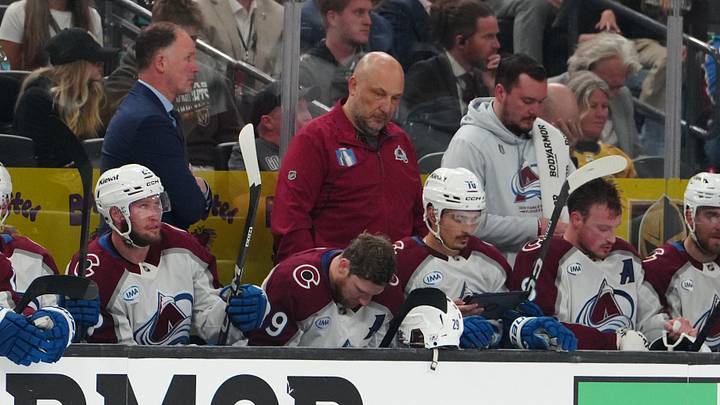
The Colorado Avalanche and their fans are likely still in a state of disbelief after going out of the Western Conference Final in four straight games. Frankly, it has been a whiplash of pain and anguish watching the best regular season club in Avalanche history crash and burn.
The Avalanche were just the fourth Presidents' Trophy-winning team to be swept out of the postseason. Most fans I know are just as shell-shocked as the Avalanche bench looked in the middle of Game 3 after their 3-0 lead evaporated and Nathan MacKinnon went down with a knee injury.
Everyone wants answers to the burning question. How did such a dominant team go out like that? As hard as it is to stomach right now, I went back and looked at some of the details underpinning the collapse.
Let me be clear, I'm not blaming the injuries here, as easy as it might be to spare my own feelings about a team I so dearly love. Yes, I used this particular photo for a reason, but not the one you might think. After all, the lead was gone in the middle of the second period, but the score was even at 3-3. Still, the vibe had turned from bad to defeated.
Indeed the Colorado Avalanche who had been characterized all year long by a rugged resilience looked like a team who had fully lost their way when staring down their own mortality. Earlier this postseason, I wrote about their inspired play against Minnesota, that looked to be fueled by the need to exorcise the ghosts of the recent past.
Later, I felt even more bullish about Colorado's chances of raising the Stanley Cup again when newer depth acquisitions played heroes to punch the Avs' ticket to the Western Conference Final. I couldn't have been more wrong, but what trend truly broke Colorado's collective back this series?
Colorado couldn't adjust in virtually any intermission
When you get swept, it's generally true that issues are varied and sometimes overwhelming to try and analyze objectively. Looking for bright spots can become a joyless task when you know the end result was devastatingly bad. Still, the first periods were mostly good in the series for Colorado; sadly the only such pocket of relative success in four excruciating contests.
In Game 1, we saw a scoreless frame to open the series. This kind of start is typical in the playoffs when two quality clubs are attempting to find their footing and it no way felt alarming as a fan to witness. In Game 2, Ross Colton scored the lone tally in a very tight battle. It seemed like the bounce-back the Avalanche needed.
Game 3 was Colorado's one shining moment of Avalanche hockey, when the 3-0 lead felt like a statement, until it unraveled. Even Game 4, with a 0-1 result after 20 minutes was somewhat encouraging because it indicated Mackenzie Blackwood was not going to fold up like a beach chair ready for Cancun. In fact. the goaltending was way down the list of reasons to blame for the epic flame out.
If we look at the second periods of all four games, a glaring problem stands out immediately. Colorado never scored in the middle frame against Vegas! That alone is an insane stat for the best scoring team in the National Hockey League. Even so, every single game was still winnable for Colorado in each of the third periods.
This should have been emboldening for a roster who were terrific closers all season. Yet, sadly it speaks directly to the headline of this article. Colorado arguably lost their identity the moment they surrendered the lead in the third period of Game 2.
In an all-time crazy statistic, the 2025-26 Avalanche were undefeated when entering the final period with a lead. That was good enough for a sterling 41-0-0 record in the regular season, or exactly half the games played! That trend stayed consistent through their 8-1 start to the postseason, again, surprisingly applying to 4 of 8 wins against the Kings and Wild.
When that seemingly uncrackable dam broke in Game 2, Colorado never quite looked like themselves again. The offensive outburst that buoyed them in Game 3 was unfortunately blasted to bits so that they never saw another lead the rest of the way against VGK.
Does this mean that Colorado got out-schemed, or out-coached? Were they too gassed late in games to mount necessary comebacks? All of that is possible, but the end result is the same however you eventually assign blame. A Colorado Avalanche team that made its Presidents' Trophy bones on getting leads and holding them finally failed at the task and never recovered afterward.
A team identity is not solely reflected in things like records. Even when they are as noteworthy as this specific example. Ultimately what defines an organization is how they respond to challenges. This year, the Colorado Avalanche shocked everyone in both their highest and lowest moments.
Detractors will likely say that the Avalanche were just one of hockey's greatest frontrunners. Perhaps the real haters will label them frauds or point to overblown curses. Maybe they had it too easy avoiding Dallas and dispatching an injured Minnesota.
Whatever the case, now begins an offseason that will be filled with tough questions about what went wrong and how to fix it. For me, though, the quandary isn't as much about who this team was—it's about who this team wants to be next year.
Changes are coming, but what kind?
I think the most pressing concern for the Avalanche is about who leads them behind the bench in 2026-27. Jared Bednar is the most successful coach in franchise history and personally, I love him. He's known to have a great relationship with the front office and ownership. But spectacular crash-outs often have dire consequences.
As has already been discussed on MHS, moving on from Bednar would be about cultural shift. For a lot of organizations, firing a coach who just helped lead you to a franchise record in regular season points would be unthinkable. But sometimes that pull of a new voice is incredibly hard to resist when you believe the roster is more than ready to win.
Bednar is a great coach by any real measure and he would immediately have high-profile suitors in places like Edmonton or Toronto if he ends up getting ousted. I'd more or less guarantee Dave Hakstol is not back next season. I wrote about regretting that hire as far back as early-February. But that, too, calls into question big picture thinking. Can you hang blame on an offensive assistant in two consecutive offseasons and otherwise keep the same staff?
Make no mistake: tThe Colorado Avalanche came close to greatness this season. Running it back with as much of this roster as possible and Jared Bednar at the helm would be considered a safe choice. For now, we'll have to wait and see what the organization wants to do.
 Add us as a preferred source on Google