

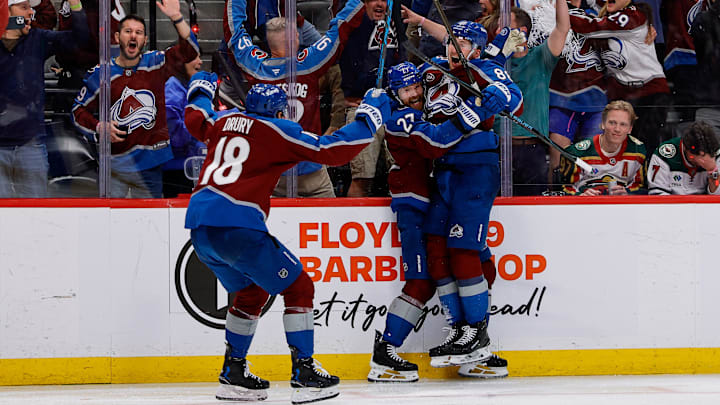
After a Game 3 loss to the Minnesota Wild, coach Jared Bednar stated that he was going to take his whole team to the film room to reemphasize how to play as a five-man unit. The forward line that epitomized this approach was not his superstar trio of Lehkonen-MacKinnon-Nečas. In fact, it was the team’s fourth line of Jack Drury, Parker Kelly, and Logan O’Connor.
Not everyone can be a superstar in the NHL, but anyone good enough to be an NHL regular can follow the blueprint that the Avs’ fourth line follows game-in and game-out. They bring a blue-collar attitude to every shift paired with the determination to outwork their opponent, no matter whether they are on the ice against the other team’s superstars or grinders.
Avalanche’s fourth line had a strong season
The core of the Avs’ fourth line was Drury and Kelly, who played the majority of the regular season as the team’s third line before Logan O’Connor returned from injury and the Avs added to their depth through the deadline additions of Nicholas Roy and Nazem Kadri. That duo collected 31 goals and 62 points between the two of them while logging heavy defensive minutes, including key time on the penalty kill.
Since the postseason began, that line has been the most consistent for the Avs. The trio of Drury, Kelly, and one of O’Connor or Kiviranta has contributed five goals and nine points through the first two rounds. That is fantastic production from the Avs’ depth players.
Foundational identity
The meat-and-potatoes approach to the play of the fourth line has resulted in Bednar holding them up as the foundational standard to which he expects all his forward lines to adhere. He extols the structure with which they play as “relentless” and praise their commitment to taking away time and space by staying “connected” to one another.
After the Game 3 loss to the Minnesota Wild, Bednar stated that he was going to show game tape of the fourth line to his players in order to set a foundational expectation of how he expects each line to play. Once they have committed to that style of play, they can then build off of it as their roles and their skillsets allow.
Coach Jared Bednar gave a lot of praise to the fourth line for their efforts last night:
— DNVR Avalanche (@DNVR_Avalanche) May 10, 2026
"That group is always connected to one another... It's often the line that we show our other lines."
Full availability ⬇️ pic.twitter.com/SAQ5J0vZG9
The trickle-up effect
The Drury-led fourth was the foundational inspiration for what it means to play Avalanche-style hockey and has had a trickle-up effect on the rest of the Avs forward lines. Since Bednar talked about showing the team game film of that trio, the Avs have shown a more consistent effort to play with pressure and a strong forecheck.
This commitment has been particularly noticeable in Martin Nečas’ recent play. For someone who is known as a skills-guy and a superstar, his dedication to being competitive both with and without the puck this postseason – particularly the last two games – has been of particular note.
With more forechecking tenacity and willingness to play the body, Nečas has layered his skill on top of that to create many important goals for the Avs like Kadri’s power play goal in Game 3, where he bodied Matt Boldy off of the puck or MacKinnon’s empty net goal where he out-competed Quinn Hughes for possession to feed MacKinnon for the empty net goal to seal that victory.
Nazem Kadri - Colorado Avalanche (2)*
— NHL Goal Videos (@NHLGoalVideos) May 12, 2026
Power Play Goal pic.twitter.com/Q76h1cjM2n
Even better, he layered his speed and vision on top of his compete level to create space to feed Brett Kulak for the game-winning and series-clinching goal in Game 5. And who was on the ice with them to help set up that goal? None other than the Avs’ two big fourth-line workhorses of Jack Drury and Parker Kelly.
 Add us as a preferred source on Google