

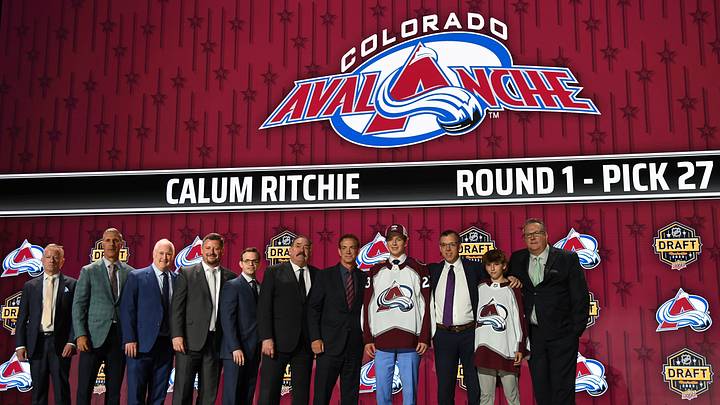
It seems that Colorado Avalanche first-round picks playing musical chairs has become a thing.
Last season, Colorado’s first-rounder changed hands numerous times. The pick originally went from Colorado to the New York Islanders in the Brock Nelson trade. Thereafter, the pick went on a bit of a ride. The Islanders traded the pick to the St. Louis Blues in the Brayden Schenn trade. The Blues moved it to the Anaheim Ducks, who then flipped it to the Vegas Golden Knights. It was Vegas that eventually used the pick.
Well, the 2028 pick is already on a similar rollercoaster ride.
The Avalanche originally sent that pick to the Calgary Flames at last year’s NHL trade deadline in the Nazem Kadri deal. The Flames used the pick to acquire Simon Nemec from the New Jersey Devils earlier this summer. The Devils now flipped the pick yet again to an Avalanche division rival, the Nashville Predators, to acquire forward Luke Evangelista on Tuesday.
That’s quite a ride for a pick that’s still two drafts away.
So, the question remains: why do Avalanche first-round picks get the runaround so much? The answer to that question is based on a good thing, actually.
Avalanche first-round picks don’t have as much value as they should
The main thing about Avalanche picks is that they don’t have as much value as other first-round selections.
Since the Avalanche are a successful team, those picks tend to end up toward the end of the first round. This year’s pick, for example, landed 29th overall.
That’s not bad. But it doesn’t compare to a top-10 or, much less, a top-5 pick. Hence, Colorado’s first-rounders, while certainly valuable, don’t have nearly as much perceived value as, say, the fourth-overall pick that the Chicago Blackhawks traded to the Buffalo Sabres for Bowen Byram.
Yes, there’s no guarantee that the fourth-overall selection will yield a superstar. But the odds of a prospect taken that high becoming a star are much higher than a player taken towards the end of the first round.
It’s also worth noting that late-round picks, irrespective of the round, don’t carry as much weight. In the first round, in particular, some teams reach for players that would have otherwise been second-rounders. That decreases the overall perceived value of the late first-round picks. Since they’re pretty much second-rounders, teams tend to flip them much more easily.
Unless the Avalanche somehow horrifically tank in the next couple of years, there’s little chance that pick gets beyond the 28th or 30th pick.
If the Avalanche win the Stanley Cup in 2028, that pick would be the 32nd selection.
Losing those first-round picks is not a bad price to pay for a Stanley Cup victory.
 Add us as a preferred source on Google